Thursday, February 28, 2013

Top 5 for Falconers

A falconer is "a person who keeps, trains, or hunts with falcons, hawks, or other birds of prey" (google definition). I've always been immensely interested in the practice. This list is for the falconers of the world, each of the flags depicting a specific bird of prey used in falconry.   
 
1. Flag of Kazakhstan
 
 
The eagle on the flag of Kazakhstan is the Golden Eagle (also referred to as a steppe eagle, but it should not be confused with the true Steppe Eagle). It is referenced in a Kazakh proverb "There are three things a real man should have: a fast horse, a hound, and a golden eagle". The saying refers to berkutchy, the renowned Kazakh profession of hunting with the raptor. Medieval Europeans considered them to be the finest of the raptors and they were handled only by Emperors.
 

2. Flag of the Azores


The Flag of the Azores tells a rather humorous story. The title of the islands comes from the Portugese word 'açor', which translates to 'goshawk', the bird of prey illustrated on the flag. The name was adopted by early explorers because goshawks were supposedly very plentiful in the islands. As it turns out, the species was misidentified, goshawks not living in the Azores at all; the bird they saw was actually a type of buzzard. The flag, adopted in 1979, acknowledges and celebrates that error. There are several species of goshawks and they are among the most popular birds used in falconry.

3. Flag of Zambia

 
The African Fish Eagle, illustrated on the flag of Zambia, in reality looks very similar to a Bald Eagle. Not only is it the official national bird of Zambia, but also of Namibia, South Sudan and Zimbabwe. The eagle on the flag also represents the Zambians' ability to rise above all obstacles or problems their country faces. African Fish Eagles are used in falconry, but far less commonly than Golden Eagles.
 
4. Flag of Iowa, USA


The Bald Eagle, found on Iowa's flag, is the national bird of the USA and appears on several other state flags. As far as I know, it's illegal to use Bald Eagles for falconry in the USA, but they can be handled in Canada with a license. Fun fact about bald eagles taken from Guiness World Records: "The largest bird's nest was built by a pair of bald eagles (Haliaeetus leucocephalus), and possibly their successors, near St Petersburg, Florida, USA and measured 2.9 m (9 ft 6 in) wide and 6 m (20 ft) deep. It was examined in 1963 and was estimated to weigh more than two tonnes (4,409 lb)." Craziness.

5. Flag of Mexico


Like the flag of Kazakhstan, Mexico's flag (also found on the "Top 5 for Snake Charmers" list) has a depiction of the Golden Eagle, the country's national bird. The bird on the flag is chowing down on a snake, but its prey is not limited to snakes alone. The Golden Eagle is not a picky eater and has been witnessed feasting on nearly 200 different animal species. They are used in falconry to hunt a variety of game, even large game such as deer and wolves!

Wednesday, February 20, 2013

Top Five for Sun Worshippers

Winter: shorter days, longer nights, the temperatures dip well below freezing, and the skies are frequently covered with snow-filled clouds. It's at this time of year that I most appreciate appearances from the sun, making the cold days feel a little less cold and depressing, giving out some much-needed Vitamin D, and melting some of the excessive ice and snow. To thank our life-giving star for its light and warmth, this list will include my five favourite flags that pay homage to the sun. There is a lot of flags depicting the sun, so this was a difficult list to compile! 

1. Flag of Donetsk Oblast, Ukraine


My favourite sun flag does not belong to a nation, but rather to a province in Eastern Ukraine, an eye-catching design of the sun rising over the Black Sea. This flag has been flown just about as close to the sun as it could get, planted by Ukrainian climbers on top of the world's highest mountain.   

2. Flag of Greenland


I love the flag of Greenland, a simple yet effective design, a red sun rising over a red ocean, surrounded by white ice. It is unique among the Nordic flags, being the only one without a Nordic Cross.

The flags of Japan ("the Land of the Rising Sun") and Bangladesh also have simple designs with a prominent red sun.

3. Flag of Argentina


The flag of Argentina is ideal for sun worshippers in the most literal sense. The "Sun of May" depicted on the flag is modelled after the Incan god of the Sun, known as Inti, worshipped by farmers in times past. A representation the sun god is also found on the flag of Uruguay.

4. Flag of Macedonia

 
"Today over Macedonia, is being born
the new sun of liberty.
Macedonians are fighting,
for their rights!"
-a verse in Macedonia's national anthem
 
5. Flag of Antigua and Barbuda
 
 
Just looking at the flag of Antigua and Barbuda makes me want to go there to escape the cold Canadian winter for a while. It's a perfect place to lay on the beach and sunbathe, well illustrated on the flag: the white representing sand, the blue representing water, and the golden sun representing the dawn of a new era.    


Saturday, October 27, 2012

Top 5 for Trick or Treaters

Every year around this time, The Flag Shop I work at gets one or more adult customers purchasing a 3' x 5' polyester flag to use for their Halloween costume. In the spirit of the season, this list is for those Trick or Treaters looking for unique cape ideas. Happy Halloween!!!

1. Racing Flags


With a variety of plain coloured flags to choose from, the racing flags make fantastic capes for various superheroes and characters. Here's a few ideas:

Green (Start): Robin Hood, Green Lantern, Green Hornet, Green Goblin
Yellow (Danger): Robin
Red (Stop): Superman, Supergirl, Thor, King or Queen, Mighty Mouse
Blue (Move to Outside): Captain America, Wonder Woman, vintage Batman, Underdog, Wizard
White (Final Lap): Storm, Good Witch, Elvis
Black (Penalty): Witch, Warlock, Vampire, Grim Reaper, Batman 

2. St. George's Cross, Flag of England


St. George's Cross is as a perfect cape for a knight costume. And it even has some authenticity, variants of the cross used throughout history to adorn knights of the Byzantine Empire, France and England. But remember: if you're going to wear a national or provincial flag, be sure to treat it with respect!

3. Jolly Roger


The pirate flags, also known as Jolly Rogers, come in a variety of designs, the most common being variants of the skull and crossbones. They are ideal, of course, for pirate capes, and could be used for Grim Reaper costumes.

4. Flag of Norway


Why not use the flag of Norway for your Viking persona? Other Scandinavian flags could also work, such as Denmark, Sweden or Iceland. And there is a historic Viking raven banner as well, although it is much harder to come across.
 
5. Rainbow Flag   


I have seen the Rainbow Flag, or Pride Flag, worn as a cape more than any other flag. Usually it is worn at Pride Festivals, but I have also known it to be used as a costume piece for queer superhero characters. And recently, a customer purchased the flag for his double rainbow costume!   

Saturday, June 23, 2012

Top 5 for Stargazers

An appropriate list for astronomers, astrologers, astronauts, and the folks like me, who can't help but gaze up at a star-filled sky with absolute wonder and awe. It is common to find stars on flags, but they rarely represent specific stars, constellations or asterisms. The following flags pay tribute to true stars. 

1. Flag of Brazil


"...the creators of our republican flag intended to represent the stars in the sky at Rio de Janeiro at 8:30 in the morning on 15 November 1889, the moment at which the constellation of the Southern Cross was on the meridian of Rio de Janeiro and the longer arm [of the cross] was vertical."
-Professor Paulo Araújo Duarte

Brazil's flag has 27 stars, coinciding with the country's 27 federative units (26 states, 1 Federal District). The stars, constellations and asterisms featured on the flag include Scorpio, Triangulum Australe (Southern Triangle), Sigma Octanis (South Star), Crux Australis (Southern Cross), Hydra (Water Serpent), Spica (brightest star of Virgo), Canopus, Canis Major (Greater Dog) and Procyon (brightest star of Canis Minor).     

2. Flag of Alaska, USA


The flag of Alaska honors one of the most recognizable asterisms in the northern hemisphere, the Big Dipper of the constellation Ursa Major (Larger Bear). The star in the upper corner represents Polaris, the brightest star in Ursa Minor, more commonly known as the North Star.   

3. Flag of Australia


There are 88 recognized constellations, and Crux, seen as the Southern Cross, is the smallest of them. It is easily the most common of the flag constellations, found not only on the flag of Australia, but also on the country flags of New Zealand, Samoa, Papua New Guinea and Brazil.  

The large star that stands alone, called the Commonwealth Star, does not symbolize a true star, but rather the Federation of Australia.

4. Flag of Durham, North Carolina, USA


Durham celebrates its birthday on April 26th under the constellation Taurus, or the Bull. The shoulder of Taurus is the bright star cluster called Pleiades, displayed on Durham's flag. The cluster is better known as the Seven Sisters, the seven daughters of the titan Atlas and the sea-nymph Pleione of Greek mythology.   

5. Flag of Nunavut, Canada


Like the flag of Alaska, Nunavut's flag pays tribute to the North Star, known by the Inuit as Niqirtsuituq. Because the star is recognized as a navigational beacon, it symbolizes the strong leadership of the territory's elders as well. 

The inukshuk, like the North Star, is used as a guidepost for travelers. These stone monuments may also mark sacred sites or food caches.


Wednesday, March 14, 2012

Top 5 for Irish Canadians

In the spirit of St. Patrick's Day (one of my favourite days of the year), I dedicate this list to my fellow Irish Canadians! The Irish flag is undeniably the most common flag used to celebrate the occasion, but this list is comprised of some alternatives that are entirely Canadian. Cheers!

1. Canadian Red Ensign (1957-1965)  


The Canadian Red Ensign tops my list, it being the most inclusive of all Irish Canadians. The ensign was the unofficial flag of Canada before the current maple leaf design was adopted in 1965; an earlier version of the flag (1922-1957) was the design under which Canadian veterans fought the First and Second World Wars. 

There are two Irish references on this flag. The first can be found in the flag's canton (upper left corner); as mentioned in my 'Top 5 for Saints' list, the flag of the United Kingdom is a combination of three saint flags, one of these being St. Patrick's Cross to represent Ireland. The second Irish symbol can be found in the flag's crest, that being the golden harp, Ireland's long-standing emblem. 

2. Newfoundland Tricolour


The Newfoundland Tricolour (also called the 'Pink, White and Green') has been around since the 1880s and is an unofficial but popular flag of Newfoundland and Labrador. Though a topic of debate, the flag is generally believed to be based upon the nearly identical flag of Ireland. Many Newfoundlanders are of Irish descent and Irish culture is still prevalent there. It is the only province in Canada where St. Patrick's Day is a holiday, and an Irish writer once wrote that Newfoundland was "the most Irish place in the world outside of Ireland". The orange found in Ireland's flag was changed to pink in order to match the official colours of a Newfoundland Catholic group established in 1871, called The Star of the Sea Association. The Tricolour is one of few flag designs in the world to utilize the colour pink.
  
3. Flag of Montreal, Quebec


Montreal has one of the oldest St. Patrick's Day parades in the world, running consecutively since 1824! The city's flag was adopted in 1939 and represents the four largest ethnic groups of that time: the fleur-de-lis for the French, the rose for the English, the thistle for the Scottish and, of course, the shamrock for the Irish.

4. Flag of St. Patrick's Battalion


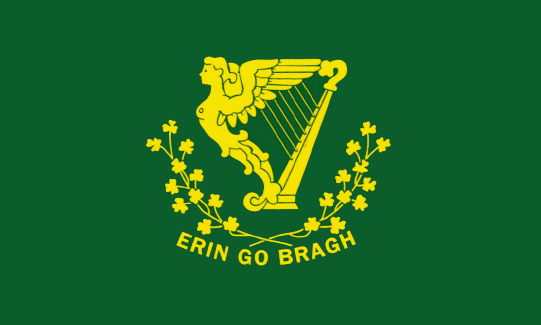
St. Patrick's Battalion fought with the Mexican Army in the Mexican-American War of the 1840s. The soldiers were primarily Europeans (many of which were Irish), but there were also some Canadians. Most had joined the Mexican effort after deserting the U.S. Army (the Mexican government had some great incentives). The Battalion's flag utilizes the Irish clovers and another common Irish image, the harp combined with the female personification of Ireland, known as Erin. "Erin Go Bragh" can be translated as "Ireland Forever." There are several different interpretations of this flag based upon a written description, the original design lost to history.

5. Polar Bear Flag, Northwest Territories


This may seem like an unlikely choice to make my list, but it turns out that being Irish Canadian isn't limited to humans only. In 2011, scientists discovered that polar bears interbred with now-extinct Irish brown bears during the last ice age. The maternal lineage of these Irish bears can actually be traced to 100% of today's polar bear population. The polar bear flag can be found on government buildings in the Northwest Territories.     

Thursday, December 1, 2011

Top 5 for Carollers

The Christmas season is a time for list-making... the wish list, the gift list, the grocery list, Santa's naughty and nice list, and now, the flag list. This holiday list is for all those people out there who love Christmas so much that they just have to sing about it.

Merry Christmas everyone!

1. Flag of North Pole, Alaska, USA


"Where the spirit of Christmas lives year 'round" is this small city's motto, and they're not kidding. No matter the season, in North Pole you'll find candy cane light poles, Christmas themed street names, the Santa Claus House, and real live reindeer (and the flag is undoubtedly the most festive government flag in the world)! I want to go!

2. Flag of Norfolk Island, Australia


Number 2 on my list is the Flag of Norfolk Island (also found in the "Top 5 for Tree Huggers" list). A potted Norfolk Island Pine is an ideal choice for a living Christmas tree. Unlike most Christmas trees, this tree thrives indoors, making it an easily maintained houseplant that can be decorated year after year during the holiday season.

3. Flag of Palestine  


"For unto you is born this day in the city of David a Saviour, which is Christ the Lord." (Luke 2:11)

The white, red and green of Palestine's flag are just an added Christmas bonus. This flag made the list because Bethlehem is found within the country's borders, which is, of course, the birthplace of Jesus (aka "The Reason for the Season"). For more information, please consult The Holy Bible.

4. Flag of Christmas Island, Australia


Christmas Island could be mistaken for a fairy tale land where snow and toys and candy abound, but in actuality this territory of Australia is tropical, boasting lush rainforest and Golden Bosuns, a bird unique to Christmas Island and illustrated on the flag. The territory was named in 1643 by William Mynors, a captain who was sailing past the island on Christmas Day.  

In the Republic of Kiribati, one will find another Christmas Island (or Kiritimati), this one discovered by Captain James Cook on Christmas Eve in 1777.

5. Flag of Turkey


This flag didn't make the Top 5 because it sounds like the main course of a Christmas meal (although the poultry is in fact named after the country). Modern day Turkey is where the ancient region of Lycia is located (once a region of Greece), the birthplace and home of another notable Christmas figure... Saint Nicholas. Every year, thousands of people make a pilgrimage to Turkey's southern coast to discover the origins of the true Santa Claus, a Christian bishop who was known to perform several miracles, later becoming the Patron Saint of Greece, as well as children, students, sailors and merchants, among other places and professions. The story of Saint Nick has obviously evolved, but he was always known for being a generous gift giver, especially to those who needed it most.         

Friday, August 5, 2011

Top 5 for Saints

Finally, a new blog post! After an amazing trip to Iceland dedicated almost entirely to writing, I found myself back in Saskatoon with a long list of responsibilities and not enough time to simply sit down and work on my blog! Hopefully I can keep up with it on a regular basis again!

The flags shown here represent Saints in the most formal sense of the word, deceased individuals who have been officially canonized by the Christian faith as holiest of holy. They have been attributed with miraculous and self-sacrificial acts, and have gone on to become Patron Saints of places and peoples the world over. This list is for them, but also for the folks in our lives who we identify as "Saints" on a personal level. We all know a few; friends, family members or acquaintances who are are just genuinely good people, always going out of their way to do the right thing or help others. The world would be a sad place without them.

I'm not a religious person myself, but the stories of the Saints are undeniably interesting. This was a difficult list to compile, the flags that represent the Saints varying only slightly. Most of them utilize a simple two-toned or three-toned cross design and are found in the United Kingdom. 

1. Union Jack              


The flag of the UK is probably the most recognizable flag in the world and also the ultimate Saint flag. It can be found in the canton (upper left corner) of numerous country, territory and military flags, as well as provincial flags in Canada (Manitoba and Ontario). By combining the following three flags, the Union Jack represents three patron Saints: St. George, St. Andrew and St. Patrick.

A. Flag of England / St. George's Cross


St. George is not only a Patron Saint of England, but of numerous other places as well, including Bulgaria, Ethiopia, Georgia, Greece, India, Iraq, Israel and Portugal, to name just a few. George was a Roman soldier, and has become known in legend as being a dragon slayer. By order of Emperor Diocletian, he was executed in the year 303 for renouncing the Roman gods in favour of his Christian faith.  

B. Flag of Scotland / St. Andrew's Cross


St. Andrew was a fisherman and biblical disciple, he and his brother Peter called by Jesus to be "fishers of men." He is a Patron Saint of Scotland, Romania, Russia and the Ukraine. The X-shaped cross found here is known as a St. Andrew's Cross or saltire; like St. George's Cross, several world flags have borrowed this simple design, though it is not representative of a Saint in many if those cases. In this case, the X symbolizes the cross upon which Andrew was crucified, supposedly shaped this way by his own request; he did not deem himself worthy enough to die on a t-shaped cross as Jesus did. The flag of Nova Scotia (or 'New Scotland') is a version of this flag with the colours inverted and the Scottish Standard (a lion crest) at its centre.     

C. Flag of Ireland / St. Patrick's Cross 


St. Patrick is perhaps the most popular Saint in the western world, commonly celebrated with drunkenness on March 17th, the date of his death. He is, of course, the Patron Saint of Ireland, though Ireland is not his homeland. He was actually captured by Irish raiders and brought there as a slave from Wales, eventually escaping, only to return as a religious figure some time later. There is a little known legend of Patrick ridding Ireland of werewolves, and he is better known for driving all the snakes out. He is partnered with the 3-leafed shamrock, which he employed to illustrate the Holy Trinity (the Father, Son and Holy Spirit). As you can see, the flag also uses the saltire. Though considered a flag of Ireland, it is not accepted by all Irish people as such, some feeling it is too closely connected with England. 

2. Flag of Cornwall, England / St. Piran's Cross   


The flag of Cornwall is my personal favourite of the Saint flags. Sometimes you just can't beat the contrast of white and black, often used to symbolize light and darkness, good and evil. In this case, the colours are meant to symbolize white tin spilling from the black ore of St. Piran's fire. St. Piran is acknowledged, in fact, for having rediscovered tin-smelting in the 6th century, making him not only a Patron Saint of Cornwall, but of tin miners as well. One legend tells of Piran being savagely tied to a mill stone and cast into a stormy sea, the waters immediately becoming calm and carrying him across to the shores of Cornwall. His flag is very similar to the flag of St. David (Patron Saint of Wales), which displays a yellow cross on a black field.

3. Flag of St. Lucia


The flag of St. Lucia is the only flag on my list without a cross design, and, in truth, it isn't really an official Saint flag at all; I just wanted to mix things up a bit! But then again, the Caribbean island of St. Lucia is named after St. Lucy of Syracuse, and that's good enough for me.  The blue symbolizes blue skies and ocean, the white and black symbolize racial harmony, and the triangles symbolize the island's two towering peaks (the Pitons). And coincidently, the yellow found on the flag represents light/sunshine, and 'light' is the meaning of Lucy's name. She is best known for being the Patron Saint of the blind. When she was supposed to be executed for her faith (year 304 - like St. George, she was a victim of Diocletian's rule), the power of God held her fast in her place, immovable even when tied to a team of oxen; neither could they burn her, so they tortured her instead by gouging out her eyes. Yikes.         

4. Flag of London, England


The flag of London mimics England's St. George's Cross with the addition of a red sword in the canton, enough to pay tribute to an entirely different Saint: St. Paul. The sword symbolizes St. Paul's matyrdom by beheading. He is one of the apostles and a significant contributor to the New Testament. He is the Patron Saint of London, and my Catholic Secondary School was named after him (which may or may not be the reason this flag made my list)! If you're a flag geek like me, you might find it interesting to know that this design is altered if flown as a banner (turned sideways), the sword always pointing upwards.  

5. Flag of Nottinghamshire, England

  
There are perhaps true Saint flags that should rather have made this list, such as the flags of St. Alban, St. Edmund, St. Petroc or St. Wite. But this is my list afterall, and in my humble opinion the new flag of Nottinghamshire is a little too awesome to not make the Top 5. The design was adopted just earlier this year, chosen by popular vote on the BBC website. Again, the cross of St. George is present, with an added bonus: the image and colours of Britain's favourite outlaw, Robin Hood. Robin Hood, of course, is not a Saint in the official sense of the word, but he did steal from the rich and give to the poor, which makes him kind of saintly, right (not that I condone stealing from anyone)? And yes, he is technically a character of folklore, but folklore is usually rooted in truth. And there is another reason I picked this flag above the others; Robin Hood is a more accurate representation of those personal Saints I mentioned in this list's introduction, the average folks who dedicate their lives to selfless (and often thankless) good deeds.